
STOP MEMORIZING FORMULAS. START SEEING THE PHYSICS.
Every SPI concept on one visual page: what the sound does, which knob changes it, what the screen shows, and the wrong answer the exam wants you to pick.
Built for sonography students preparing for the ARDMS SPI registry exam, first attempt or retake.
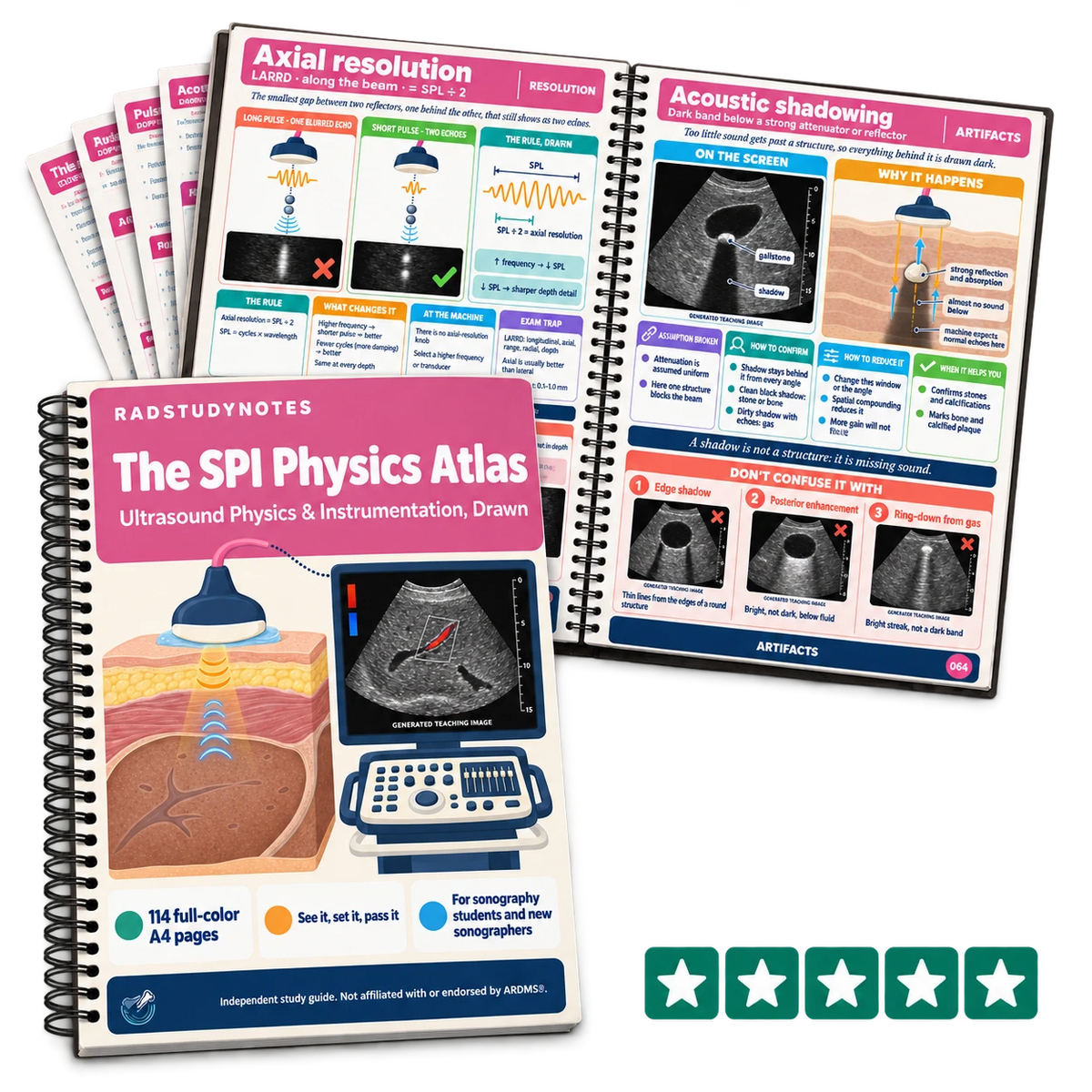
The SPI Physics Atlas
The SPI Physics Atlas
Digital & Printable Version
2026 Edition. Built for the ARDMS SPI registry exam. You can memorize every formula and still freeze when the SPI shows you an image and asks what to change. That is where most points disappear: about 110 questions in two hours, and most of them built around images, not equations.
This Atlas draws every concept the way the exam tests it, with the physics, the knob, the screen and the trap answer on the same page.
👁️ See it: every SPI concept drawn as it happens
🎛️ Set it: every knob linked to the image it changes
🖥️ Read it: images set right and set wrong, side by side
⚠️ Pass it: the trap answers flagged before they cost you points
🌊 Doppler drawn in depth, because it is 34% of the SPI content outline
📚 114 visual A4 pages mapped to the ARDMS SPI content outline
📱 Instant access. Study on your phone, tablet, laptop or printed pages
🎯 SPI REVIEW | RETAKE PREP | SCAN LAB | KNOBOLOGY 🎯
Couldn't load pickup availability

The SPI Physics Atlas
SONOGRAPHY STUDENTS SAY IT BEST

WHAT’S INCLUDED
114 visual A4 pages. 10 focused sections. Every topic on the ARDMS SPI content outline, plus hemodynamics and quick reference tools.
See the beam. Know which knob changes it. Understand what the screen should show. Catch the trap answers that cost points.
No walls of equations. No pages of filler. Just the physics the SPI tests, drawn so you can see it, set it and recall it under the clock.

🔊 Sound & Tissue
How sound behaves in the body
· Frequency, wavelength, period and propagation speed
· PRF, PRP, duty factor and the range equation
· Decibels and attenuation
· Acoustic impedance, reflection and refraction
· Scattering and echogenicity
🔦 Transducers & Resolution
From the crystal to the image detail
· The piezoelectric element, damping and bandwidth
· Beam anatomy and focusing
· Linear, convex and phased arrays
· Axial, lateral, elevational and temporal resolution
· The resolution trade off table
🎛️ The Machine
Every control and what it does
· Output power versus receiver gain
· Overall gain, TGC and dynamic range, set right and set wrong
· Pre and post processing, compounding and persistence
· Harmonic imaging and contrast agents
· A mode, B mode, M mode, panoramic, 3D/4D and elastography
🧩 Artifacts
Built from the machine's seven assumptions
· Reverberation, comet tail and ring down
· Acoustic shadowing and posterior enhancement
· Mirror image, propagation speed error and refraction
· Side lobes, grating lobes and slice thickness
· Artifact quick finder
🫀 Hemodynamics
How blood moves before Doppler measures it
· Laminar, plug and turbulent flow
· Pressure, resistance, Bernoulli and continuity
· Stenosis
· High and low resistance waveforms
· Venous flow
🌊 Doppler
34% of the SPI, drawn in depth
· The Doppler effect, equation and angle
· Continuous wave and pulsed wave Doppler
· Aliasing, the Nyquist limit and six ways to fix it
· Spectral and color controls, power and tissue Doppler
· Flow reversal or aliasing, Doppler artifacts and quick finder
🛡️ Safety & QA
Bioeffects, quality and the patient
· Thermal bioeffects and TI, mechanical bioeffects and MI
· ALARA and output limits
· Quality assurance, phantoms, sensitivity and specificity
· Infection control, transducer care and ergonomics
⚡ Quick Reference Tools
The night before the exam
· Formula sheet
· Relationships master table
· Every knob and what it does
· Typical values on one page


THE EXAM DOES NOT ASK WHETHER YOU MEMORIZED THE FORMULA.
It asks whether you can read the image.
On the SPI you need to connect the physics, the control on the machine, the image on the screen and the answer the question is really looking for, in about one minute per question.
Your textbooks often teach those pieces across different pages and chapters.
The Atlas brings them together in one visual workflow, so you can review faster, build stronger recall and stop guessing when the image, the question or the patient is in front of you.
See the beam. Understand the image. Recall it when it counts.

FAILED THE SPI ONCE? DON'T STUDY THE SAME WAY TWICE.
Every retake costs $275 and a 60 day wait before you can sit it again.
Practice questions train you to recognize answers you have already seen. The SPI shows you images you have never seen. The Atlas trains that second skill: seeing what the beam, the knob and the screen are doing, so a new image still makes sense.
Less memorizing. Less second guessing. More clarity on exam day.
Built for sonography students worldwide who refuse to let dense physics chapters decide how confident they feel on exam day.
Excellent 4.9 / 5

The SPI Physics Atlas
The SPI Physics Atlas
Product Specification and FAQ
Product Specification
Product Specification
Format: High resolution digital PDF, 114 A4 pages, in a print version and a tablet version
Content: Visual ultrasound physics guidance covering sound and tissue, transducers, resolution, the machine, artifacts, hemodynamics, Doppler, safety and QA, and quick reference tools
Study Tools: Physics diagrams, knob by knob guidance, images set right and set wrong, exam trap boxes, artifact and Doppler quick finders, a formula sheet and a relationships master table
Organization: Color coded visual frameworks built to make dense physics concepts easier to understand and recall
Use Case: Supplemental personal study resource for lectures, scan lab, competencies and exam revision
Access: Instant digital access on iPad, tablet, desktop, or smartphone. Print at home for offline review
Delivery & Access
Delivery & Access
Delivery Method:Instant digital download sent by email
Delivery Time: Access the complete Atlas immediately after purchase
Devices: Open the PDF on your phone, tablet, laptop or desktop
Support: Contact us if you experience any problem accessing your files
Can I print the study guide?
Can I print the study guide?
Yes, the PDF is printable. You can print it out for physical reference or use it digitally on your devices.
Can this help me prepare for the ARDMS SPI, CCI, ARRT Sonography and university exams?
Can this help me prepare for the ARDMS SPI, CCI, ARRT Sonography and university exams?
Yes. The Atlas supports focused review of ultrasound physics and instrumentation: sound and tissue, transducers, resolution, image optimization, artifacts, hemodynamics, Doppler, safety and QA.
These areas are relevant to ARDMS SPI review, CCI and ARRT Sonography preparation, Sonography Canada exams, university assessments and scan lab competencies.
It is not a complete official exam course. It is the visual physics resource you use alongside your official exam content outline, program materials and textbooks.
Who is it for?
Who is it for?
The Atlas is built for sonography and DMS students who want ultrasound physics to feel clearer, faster to review and easier to recall.
It is especially useful for visual learners, ARDMS SPI candidates and retakers, students working toward RDMS, RDCS or RVT, CCI and ARRT Sonography candidates, internationally educated sonographers, and anyone preparing for university exams, scan lab or competency assessments.
Is this enough to pass the SPI?
Is this enough to pass the SPI?
The Atlas is built to make the physics understandable and easy to recall, which is the part most students struggle with. Use it together with practice questions: questions build speed, the Atlas makes every answer make sense. It is not an official exam course and no study resource can promise a score.
I already failed the SPI. Will this help?
I already failed the SPI. Will this help?
It is built for exactly that situation. Most retakers did not study too little, they studied physics as words and formulas while the exam asks about images. The Atlas shows every concept as a picture with the knob and the screen next to it, and flags the trap answers, so the retake starts with a different method.
Is it updated for the current SPI content outline?
Is it updated for the current SPI content outline?
Yes. The 2026 Edition is mapped to the ARDMS SPI content outline in force since 2023, including the weight of each domain. Doppler, the largest domain at 34%, gets its own in depth section.
Do I need to be good at math?
Do I need to be good at math?
No. Every formula is shown as a picture first, so you understand the relationship before you see the equation. The quick reference section puts every formula and relationship on one page for the final review.
Still have questions?
Still have questions?
You can reach us anytime at info.radstudynotes@gmail.com for support.